

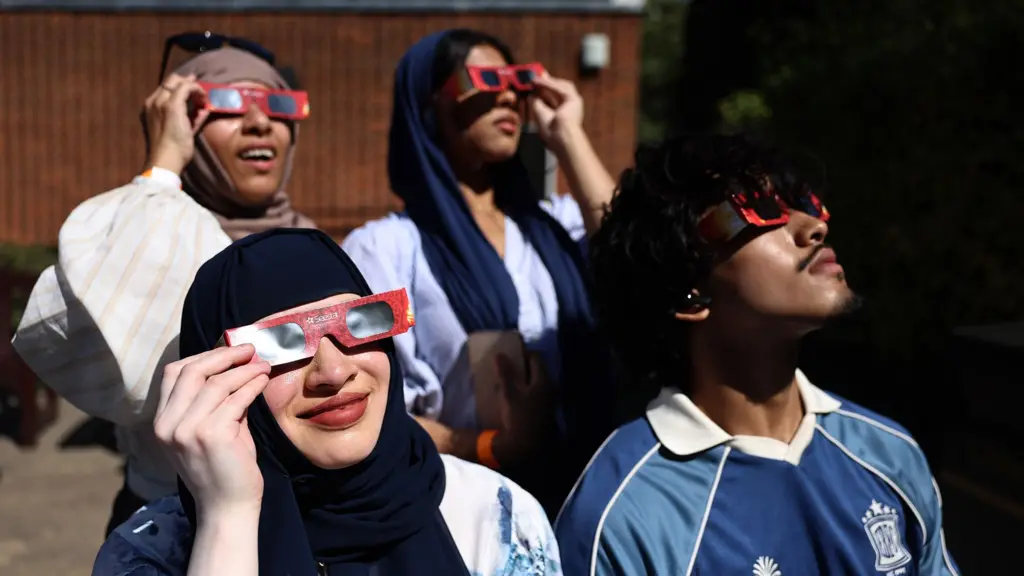
SPAIN, Nigeria — Millions of people across Europe turned their eyes to the sky on Wednesday as a rare total solar eclipse moved across the continent, creating a dramatic midday darkness along its narrow path of totality.
The celestial event began over remote parts of Russia before crossing the Arctic and Greenland, reaching Iceland. It then moved towards Spain and a small part of Portugal, where large crowds had gathered at viewing locations.
This marked the first total solar eclipse visible from mainland Europe in over two decades, transforming parts of the continent into temporary centres for astronomical tourism.
In Spain’s Mallorca, visitors travelled from countries including the United States, Russia, Belgium, and Germany to witness the Moon completely obscure the Sun. The island was anticipated to provide a particularly striking view of totality.
Iceland also attracted visitors from around the world. Organisers of the Iceland Eclipse Festival reported that people from 75 countries gathered at a waterfall to experience the event, despite concerns over cloud and rain.
In England, where the eclipse was partial rather than total, families and tourists gathered at Land’s End in Cornwall. Approximately 90% of the Sun was expected to be covered, with spectators prepared with camping chairs, picnic blankets, and eclipse glasses.
The spectacle was not only a public event but also an important opportunity for scientists. During totality, the Moon blocks the Sun’s bright surface, allowing researchers to study the solar corona, the outer atmosphere of the Sun that is normally difficult to observe due to its intense brightness.
Scientists were also watching for a phenomenon known as shadow bands—faint, rapidly moving lines that can appear on the ground shortly before and after totality. Although researchers have theories about their origin, there is still no definitive explanation for the phenomenon.
The eclipse also highlighted efforts to make astronomy more accessible. Special LightSound devices converted changes in sunlight into sound, allowing individuals who are blind or have low vision to experience the progression of the eclipse. More than 50 public viewing events in Spain were expected to feature this technology.
Totality during Wednesday’s eclipse could last for up to 2 minutes and 18 seconds. Scientists state that such events are rare at any particular location because the Moon’s shadow covers only a relatively narrow portion of Earth’s surface.
The next total solar eclipse visible from parts of southern Spain, North Africa, Saudi Arabia, and Yemen is expected on August 2, 2027, offering skywatchers another major opportunity to witness one of nature’s most dramatic spectacles.



Comments (0)
No comments yet. Be the first to share your thoughts!
Leave a Comment